



If you’re exploring solar energy, battery storage, or home energy optimization, the first fundamental concept you need to understand is: what’s the difference between direct current (DC) and alternating current (AC), and what roles do they play in solar energy systems?
This article explains the core differences between DC and AC in simple terms, then transitions naturally to their roles in photovoltaic (PV) and energy storage systems.
Understanding DC vs AC
What Is Direct Current (DC)?
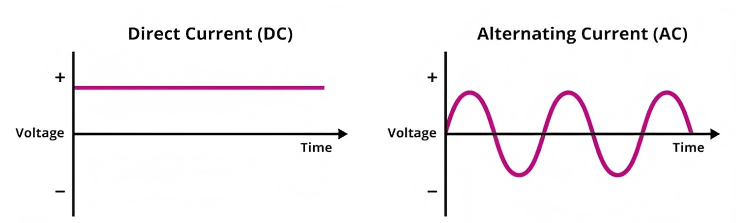
Definition: Direct current (DC) is a type of electrical current where electricity flows continuously in one constant direction, from positive to negative, with a stable voltage.
Analogy: Like a river flowing steadily in one direction downstream.
Typical Sources: Batteries, fuel cells, and solar PV panels.
Common Uses: Smartphones, laptops, LED lights, and EV batteries—most electronic devices run internally on DC power.
What Is Alternating Current (AC)?
Definition: Alternating current (AC) is a type of electrical current where the flow of electricity changes its direction periodically, typically in a sine wave pattern.
Analogy: Like ocean waves moving back and forth—forward, then backward.
Typical Sources: Power plants and standard grid wall outlets.
Common Uses: Home lighting, refrigerators, air conditioners, and washing machines—most household appliances run directly on AC power.
| Aspect | Direct Current (DC) | Alternating Current (AC) |
| Current Direction | Unidirectional, stable | Periodically reverses (e.g., 50 or60 times/sec) |
| Voltage Waveform | Straight/constant | Sine wave |
| TransmissionDistance | Better for short distances(traditional use) | Efficient for long distances viatransformers |
| Typical Sources | Batteries, solar panels | Power plants, electrical grids |
| Home Use Cases | Internal electronics, storagebatteries | Wall outlets, major appliances |
Tip: Many devices “plug into AC,” but internally convert it to DC first—that’s why chargers get warm. They are performing rectification and voltage regulation to power the internal electronics.
From Basics to Applications: The Roles of AC and DC in Solar Energy Systems
When we shift from “what electricity is” to “how electricity is used,” especially in solar + storage + home energy optimization scenarios, the division of labor between AC and DC becomes critical. This is exactly what Green Power PV focuses on: making new energy generation, storage, and consumption more efficient, safer, and more cost-effective.
Solar PV Panels: Naturally Produce DC
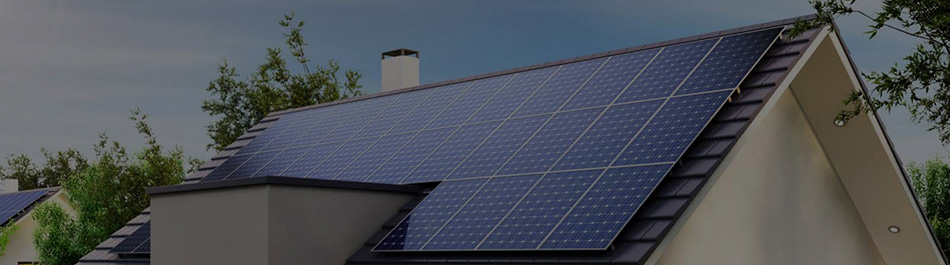
Photovoltaic cells generate unidirectional current when exposed to sunlight, so their output is DC. This is why rooftop or ground-mounted solar arrays, combiner boxes, DC-side cabling, and protection devices are all designed around a “DC system.” You can explore our high-efficiency solar panels to see how this direct power is captured.
Inverters: Converting DC to AC for Grid and Home Loads
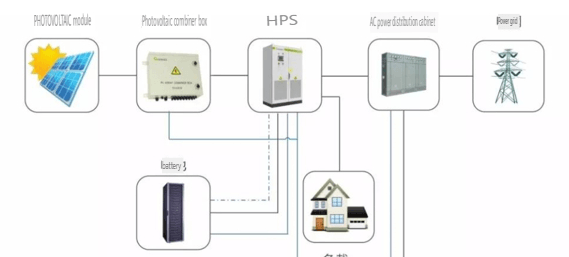
The core function of a solar inverter is to convert DC from solar panels into grid-compliant AC (e.g., 230V/50Hz or 120V/60Hz). This enables solar power to:
- Directly supply AC household loads (lights, AC units, refrigerators)
- Feed excess energy into the public grid (grid-tied systems)
- Coordinate with storage in hybrid energy systems.
Battery Storage: Stores DC, Requires Re-inversion for Use
Battery charging and discharging are inherently DC processes, meaning the DC side of storage systems is electrically more compatible with the DC side of PV systems. However, when supplying AC loads or feeding into the grid, DC must still be converted back to AC via an inverter.
In advanced architectures, utilizing a high-performance hybrid inverter or DC buses reduces multiple conversion stages, significantly improving overall system efficiency.
Why AC/DC Co-Design Affects System Efficiency and Cost
Every DC-to-AC or AC-to-DC conversion incurs efficiency losses and heat. Therefore, system architecture—centralized inverters, string inverters, microinverters, or choosing between DC-coupled vs AC-coupled storage—directly impacts:
-
Overall system efficiency (total kWh output);
-
Equipment cost and maintenance complexity;
-
Safety and fault isolation capabilities.
At Green Power, our solution design typically considers roof conditions, load profiles (day/night usage), and grid-tied or off-grid requirements to recommend the optimal inverter type and solar battery storage integration method.
Practical Tips for Home and Business Energy Scenarios
-
If you’re focused on home solar + storage: Understanding DC/AC helps you evaluate whether you need a hybrid inverter and how to properly match battery capacity with inverter power.
-
If you’re interested in small off-grid or backup systems: Supplying DC loads (like specific LEDs, routers, or security cameras) directly from a DC source reduces conversion stages, boosting efficiency and reliability.
-
If system safety is a priority: DC-side and AC-side protection devices, grounding methods, and fault-interruption strategies differ—professional system design significantly reduces operational risks.
Conclusion: From “Understanding Electricity” to “Using Electricity Well”
Understanding direct current vs alternating current isn’t just about knowing whether the current direction changes—it’s about making better technical and economic decisions in new energy systems. Whether you’re planning rooftop solar, configuring storage, or optimizing your energy usage, mastering AC/DC fundamentals helps you evaluate solutions, communicate needs, and choose the right products.
Harness the power of the sun with Green Power — building a cleaner energy future through reliable solar solutions.
Post time: Jul-20-2026


