




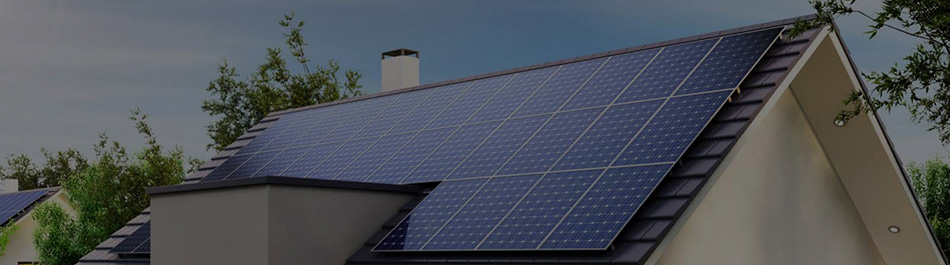
Grid prices keep rising, and ESG rules are getting stricter. These pressures are pushing commercial and industrial businesses to find better energy solutions. C&I solar storage has become a clear answer.
What Is C&I Solar Storage? Definition & Core Features
C&I solar storage is a distributed energy system built for factories, warehouses, and commercial buildings. It pairs on-site photovoltaic generation with industrial-grade batteries to form a self-contained power supply unit.
In terms of core functions, the system captures solar energy during the day and stores excess power in batteries. It supplies that stored power when solar generation drops or grid electricity rates are high. It can also disconnect from the grid and operate independently during outages.
Components of C&I Solar Storage System
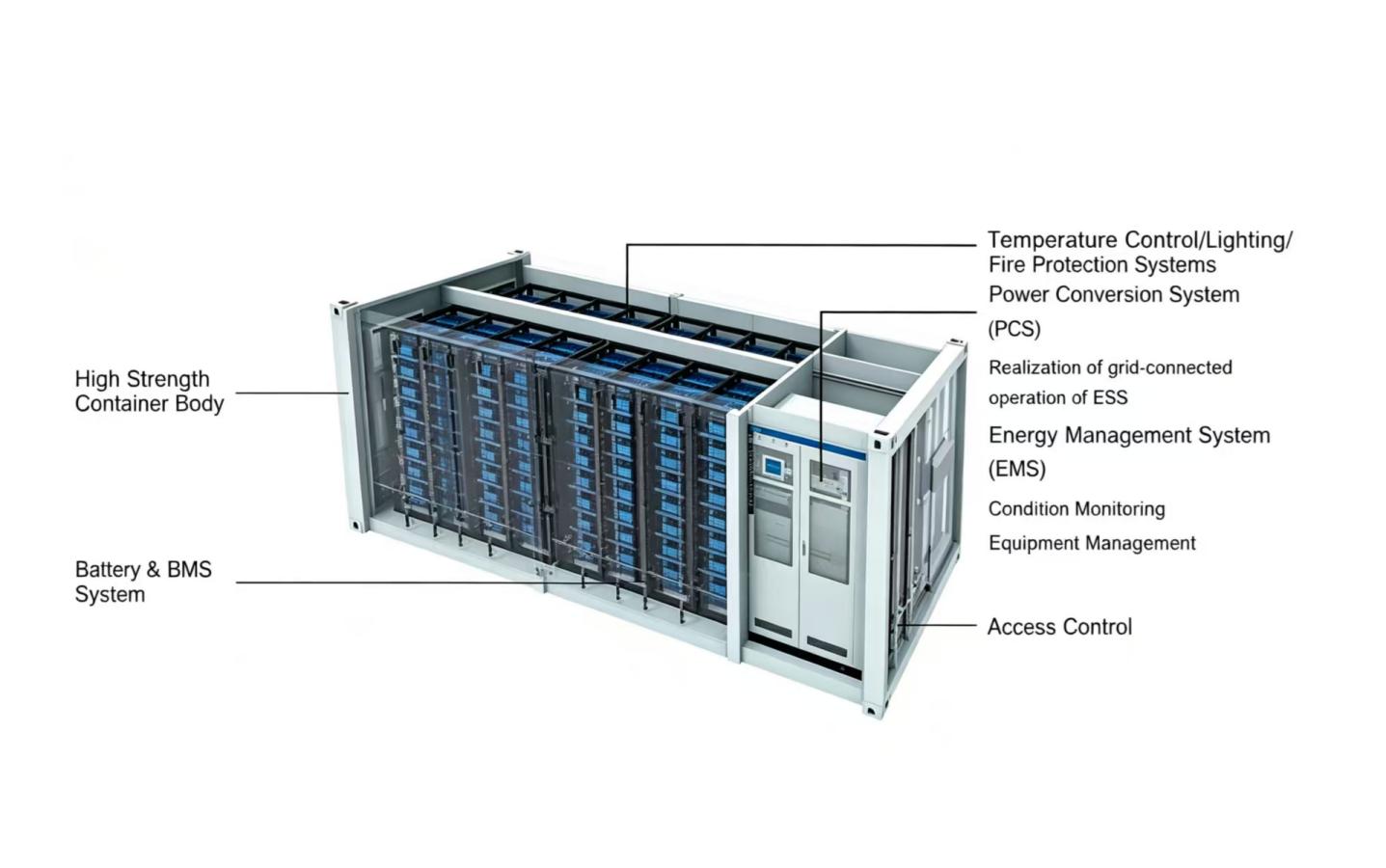
A C&I solar storage system integrates multiple physical and digital components. These parts work together to form a complete energy solution. The system consists of five core components, each introduced below.
Solar Panels:Solar panels, also known as PV modules, are semiconductor devices that convert sunlight into direct current (DC) electricity through the photovoltaic effect. They are typically installed on rooftops or open ground.
Battery Storage:Batteries are electrochemical energy storage devices that convert electrical energy into chemical energy for storage and back into electrical energy when discharged.
Power Conversion System (PCS):PCS is a power electronic device that enables bidirectional conversion between DC and AC power. It converts DC into AC through an inverting process, and converts AC into DC through a rectifying process. In addition, it manages charge and discharge cycles, maintains grid synchronization, and provides islanding protection and power quality regulation.
Energy Management System (EMS):EMS is a control platform consisting of both hardware and software. It monitors real-time data from all components, optimizes energy flow, and coordinates system operations based on user settings and grid conditions.
Accessory Components:Accessory components include DC and AC wiring, switchgear, circuit breakers, surge protection devices, and metering equipment. These parts ensure safe, stable, and compliant electrical distribution throughout the system.
How Does a C&I Solar Storage System Work? Working Principle
A C&I solar storage system operates like a self-contained power station for businesses. It works in four stages: generation, processing, dispatch, and system coordination. Here is how each stage works.
Producing Power (Generation)
Solar panels are made up of many small photovoltaic cells. When sunlight hits these cells, they generate electricity in the form of direct current, or DC. This is the same type of power that comes from a battery. However, most commercial and industrial equipment runs on alternating current, or AC—the standard electricity supplied by the grid. So the DC power from solar panels cannot be used directly. It needs to be converted before it can be used, which brings us to the next stage.
Processing Power (Conversion & Storage)
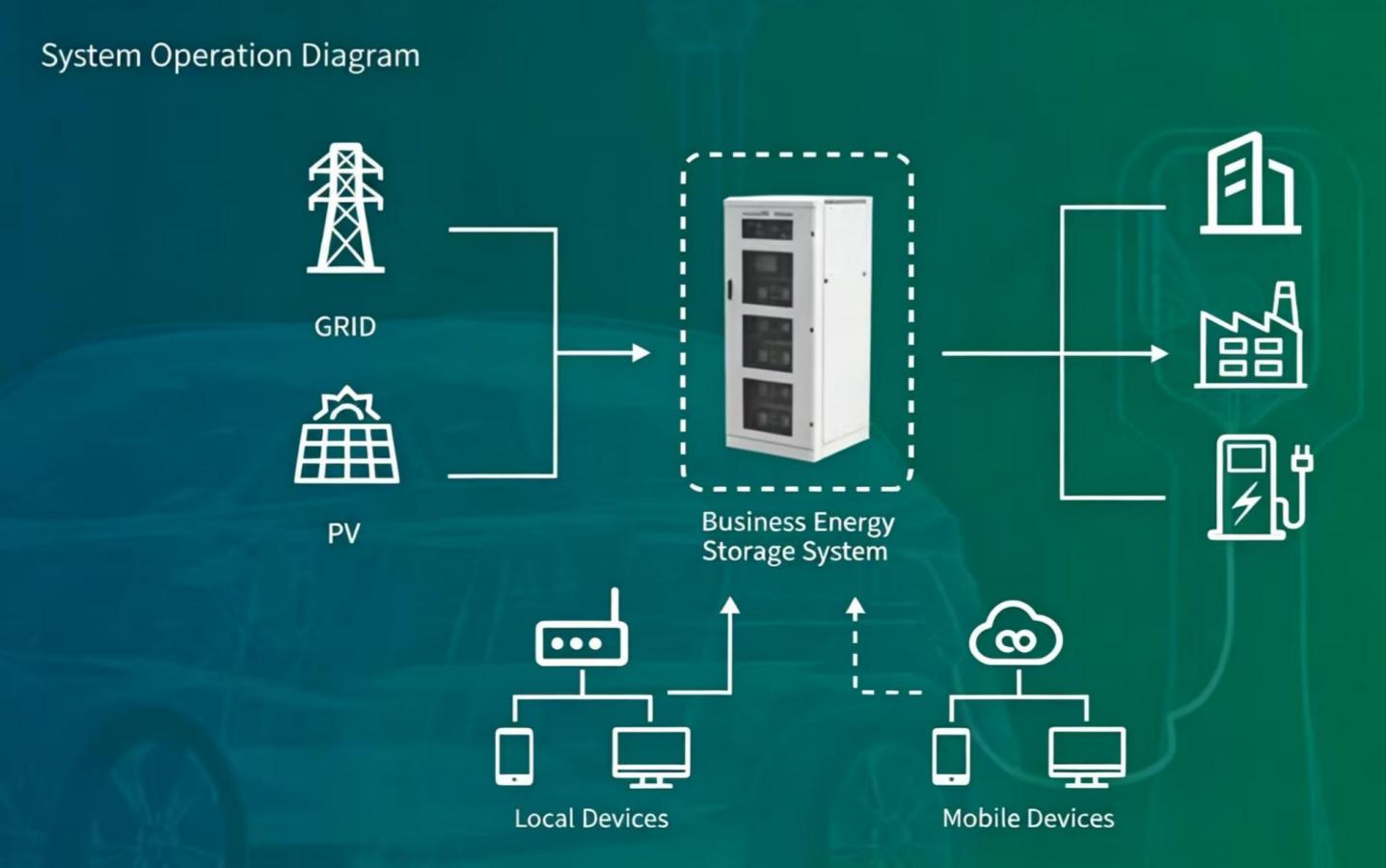
The DC power generated in the first stage flows into the PCS. Once there, the system evaluates real-time facility demand and decides how to direct the power. There are two possible scenarios:
When facility demand is higher than solar generation,all available DC power from the solar panels is routed through the PCS. The PCS converts this DC power into AC power immediately and supplies it directly to the facility’s equipment. Since all generated power is needed to meet current demand, there is no surplus left over for the batteries. In this scenario, the batteries remain idle.
When solar generation exceeds facility demand,the system splits the DC power into two streams. The first portion—enough to cover current facility needs—is sent through the PCS, converted from DC to AC, and delivered to the equipment. The second portion, which is the surplus beyond what the facility requires, is directed to the batteries instead of being converted. The PCS adjusts the voltage and current of this surplus DC power to match the battery’s charging specifications, then delivers it to the batteries. The batteries store this energy in chemical form, holding it until it is needed at a later time.
Delivering Power (Dispatch)
When solar power is not available or insufficient, the system retrieves stored energy from the batteries. The DC power withdrawn from the batteries flows into the PCS, which converts it into AC power and supplies it to the facility.
System Coordination (Grid & EMS)
The C&I solar storage system also interacts with the public grid in two ways. First, when both solar and battery power are insufficient, it automatically draws AC from the grid as a backup. Second, when electricity prices are low—typically at night during off-peak hours—it draws AC from the grid, converts it to DC through the PCS, and recharges the batteries. This prepares the batteries for use during peak rate periods the next day.
Key Applications of C&I Solar Plus Storage
C&I solar storage is designed for commercial and industrial facilities that face high energy costs, critical power needs, or limited grid reliability. The following are some of the most common and effective application scenarios.
Manufacturing & Industrial Parks
Manufacturing facilities run heavy machinery with high starting currents and variable schedules. This creates demand spikes that inflate peak charges. Grid instability can also disrupt production.
Greenpower’s ESSO 100K and ESSO 215K systems are built with fast-response power electronics and real-time load-following software, allowing them to smooth out demand spikes instantly. For large industrial parks, the ESSC 1000K system offers scalable storage capacity and grid-isolation capability, ensuring production continues uninterrupted during grid disturbances.
Cold Storage Facilities
Cold chain and food processing facilities run refrigeration equipment that demands uninterrupted power. Grid volatility and blackouts lead to massive inventory damage and heavy economic losses. Greenpower solar-storage hybrid systems adopt fast-response battery modules to stabilize refrigeration operation. The unit provides instant backup power during grid faults, removing outage risks and lowering regular power costs for cold chain businesses.
Commercial Buildings & Warehouses
Office buildings, shopping malls and logistics warehouses carry stable power loads and have ample rooftop space for solar panels. Surplus PV power will be wasted without energy storage equipment. Greenpower compact 105kW/261kWh energy storage system applies intelligent EMS to boost on-site solar self-consumption and reduce peak grid electricity usage.
EV Charging Stations
Commercial fast chargers generate instant power spikes, resulting in grid overload and voltage deviation. These issues limit station expansion and reduce operational efficiency. Greenpower 600kW liquid-cooled ultra-fast charging post integrates energy storage to dynamically buffer peak loads, stabilize local power quality and solve grid matching difficulties for charging projects.
Core Advantages of Commercial & Industrial Solar Storage
As mature, globally recognized commercial battery storage solutions, C&I solar storage delivers multi-dimensional sustainable value for international enterprises.
Economically, it reduces global corporate annual energy expenditures through peak-valley tariff arbitrage and elevated PV self-consumption rates, ensuring stable long-term ROI for global projects.
Operationally, it provides independent emergency backup power to mitigate operational losses caused by regional grid fluctuations and international power outages.
Sustainably, it helps global enterprises comply with international ESG frameworks, global carbon disclosure standards, and cross-border green supply chain requirements, enhancing global brand competitiveness.
Additionally, modular global-standard design supports flexible capacity expansion to accommodate growing power demands for international business scaling.
Key Considerations for C&I Solar Storage Projects
While commercial solar storage delivers prominent global value, investors should evaluate several key planning factors.
Firstly, projects require moderate upfront capital investment.Greenpower’s modular design supports phased deployment to ease initial costs.
Secondly, batteries have a fixed lifespan requiring ongoing maintenance. Greenpower’s remote monitoring platform simplifies global O&M management.
Additionally, project ROI varies by region due to local energy policies and grid regulations. Greenpower’s local teams provide feasibility studies to help clients maximize returns.
Frequently Asked Questions
Q: What is the difference between C&I solar storage and pure PV systems?
A: Standalone PV systems cannot store electricity, resulting in wasted surplus solar energy and continuous reliance on expensive public grid power during peak demand. C&I solar storage stores excess PV power for on-demand dispatch, significantly improving global enterprise energy autonomy, cost-efficiency, and operational power stability.
Q: What is the typical payback period?
A: Most mature international C&I solar storage projects deliver stable payback within 3–6 years, with a system operational lifespan exceeding 10 years, ensuring long-term sustainable returns for global investors.
Q: Can commercial energy storage work without solar panels?
A: Yes. Standalone commercial energy storage operates independently without PV systems, generating steady returns globally via grid peak-valley arbitrage, industrial demand charge management, and blackout emergency backup power.
Q: Is C&I solar storage hard to maintain?
A: Modern global-standard intelligent storage systems support 24/7 remote monitoring and automatic fault diagnosis, minimizing on-site manual maintenance workload and adapting to lightweight global operational standards.
Q: Which scenarios gain the most benefits?
A: High-consumption, non-stop operational scenarios achieve the highest global ROI, including international manufacturing factories, industrial parks, cold chain facilities, commercial building complexes, and public EV charging stations.
Final Conclusion on C&I Solar Storage
C&I solar storage enables enterprises to cut energy costs, stabilize grid power and accelerate low-carbon upgrading, making it a mainstream energy transition solution for commercial and industrial scenarios.
With mature certified products and extensive overseas experience, Greenpower provides reliable, customized C&I energy storage solutions for global commercial and industrial projects.
Website:www.fgreenpv.com
Email:Info@fgreenpv.com
WhatsApp:+86 17311228539
Post time: Aug-11-2026


