




As an energy storage manufacturer, we regularly talk to homeowners and solar distributors worldwide. One of the most frequent questions we get is:
“What is voltage, and how do I know if this battery matches my home?”
Reading technical terms like Volt, Nominal Voltage, AC, and DC on a specification sheet can feel like reading a foreign language if you don’t have an engineering background. But understanding the role voltage plays in your power system is the secret to choosing equipment that runs safely and efficiently, without unexpected damage to your appliances. In this quick guide, we’ll break down what voltage means using a simple water analogy, show you exactly how to check voltage on a spec sheet, and help you find the perfect match for your home appliances.
The Ultimate Analogy: Voltage Is Just“Water Pressure”
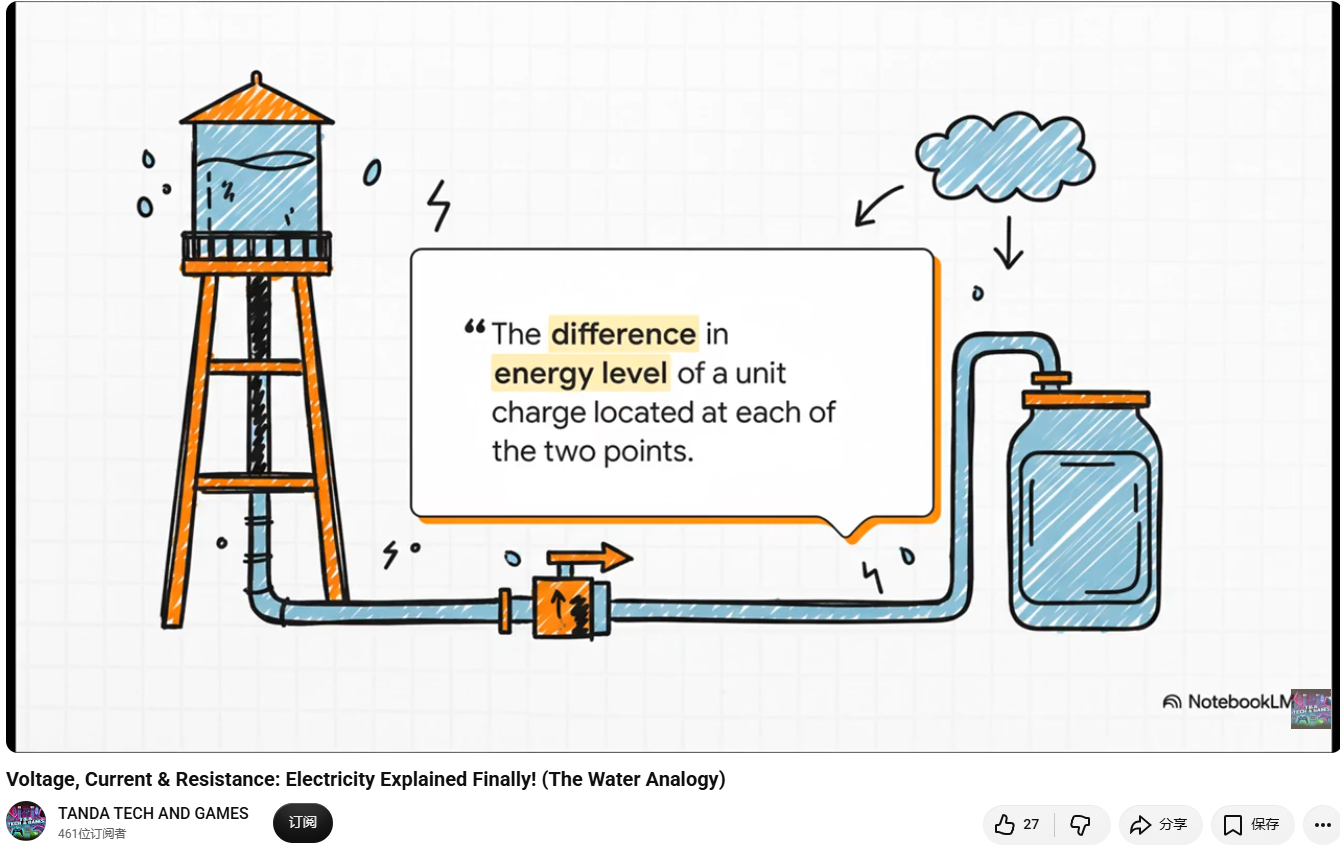
To understand voltage without getting bogged down in physics formulas, let’s imagine electricity as water flowing through a household pipe.In this scenario:
- Voltage = Water Pressure (the push)
- Current = Water Flow (the volume of water moving)
- Resistance = Pipe Size (the restriction)
Here’s how that “push” actually works in real life.
1. No Pressure, No Flow
If a water pipe is lying flat on your lawn, the water inside stays still. It has no force to move or power anything. In electricity, if there’s no voltage, electrons can’t move — meaning your devices stay dead.
2. High Pressure Creates Power
Now imagine connecting that pipe to a water tower high on a hill.Gravity forces the water down with intense pressure. That pressure drives the water forward, giving it enough force to turn a waterwheel.This is exactly the role voltage plays. Voltage acts as the invisible push that forces electrons through the wires. Once those electrons start moving, you get an electrical current, and your appliances come to life.
3. Stronger Push = Higher Voltage
- Low Voltage (Low Pressure): Think of a standard 1.5V AA battery. The push is tiny — just enough to power a TV remote or aflashlight.
- High Voltage (High Pressure): Think of your household wall sockets (110V–240V). The push is much stronger, delivering the power that heavy-duty appliances like air conditioners and refrigerators need to start up.
You can watch the following video to learn more:
How to Read Voltage on a Solar Energy Storage System
Now let’s put theory into practice. When evaluating an all-in-one solar energy storage system, you’re actually looking at two different voltage systems working together.
Let’s use our popular 5kWh all-in-one system spec sheet as a realworld example.
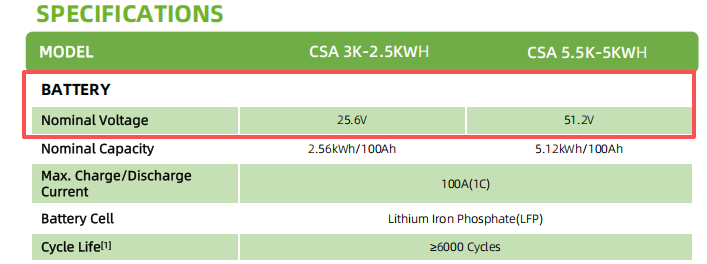
1. The Internal Battery Pressure: Nominal Voltage(51.2V)
What this actually means:
The Volt (V) is the base unit of voltage. Nominal voltage simply refers to the battery’s average operating voltage under everyday conditions— it’s different from the voltage when the battery is fully charged or nearly empty.
For a 5kWh home storage system, 51.2V is the standard for lowvoltage (LV) systems. It strikes the right balance: efficient for storing power, while staying within a range that’s safe for residential installation.
2. The Output Pressure for Your House: Output Voltage (220V–240V)
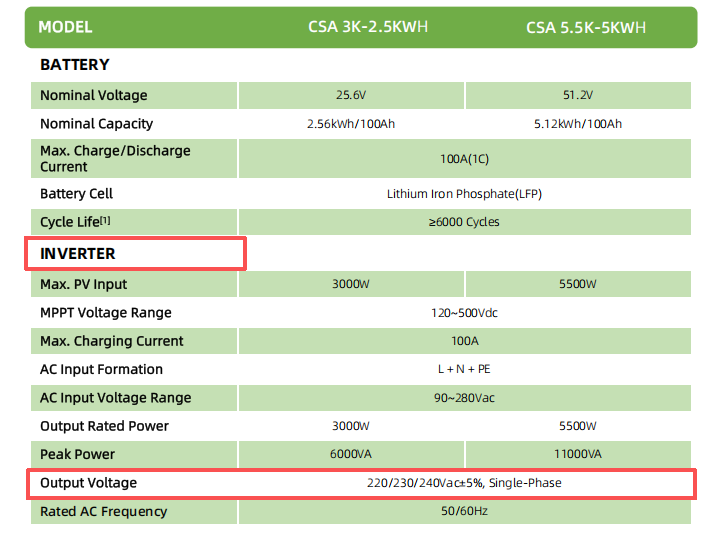
Now look at the “INVERTER” section, and you’ll find Output Voltage:220V / 230V / 240V AC.
What this actually means:
This is the actual electrical pressure that comes out of the machine’s plugs to power your house.
Why Do We Need Both AC and DC Voltage?
You might wonder: if the battery runs at 51.2V, why does the machine output 230V? And what’s the deal with AC and DC?
- DC (Direct Current): Think of this as a one-way street — electrons flow in one steady direction. Lithium batteries, EV batteries, and solar panels naturally store and produce DC power.
- AC (Alternating Current): Think of this as a two-way street, where the current direction switches back and forth continuously, like waves.
Here’s the catch: your house runs on AC. Your fridge, TV, washing machine, and microwave were all designed to run on the AC power supplied by the grid, and a 51.2V DC push on its own isn’t enough to run these appliances directly.
That’s why an all-in-one solar energy storage system is so convenient— it has a built-in inverter that acts as a translator. It takes the 51.2V DC power stored in the battery, steps it up, and converts it into standard 230V AC power your home can use.
How Do You Know if the Voltage Matches Your Home?
Before you commit to a new energy storage system, there are just two things to check. We call it the “Perfect Match” test.
Step 1: Check Your Local Grid Voltage
Different countries use different electrical standards:
- Europe, UK, Australia, South Africa, and most of Asia: Mostly 230V / 50Hz (or a 220V–240V range)
- North America (USA/Canada), Taiwan, and Japan: Mostly 110V–120V / 60Hz
bottom of a standard appliance in your home, like an electric kettle or hair dryer. Find the label that says something like “INPUT: 220–240V~ 50Hz.” That’s your local standard.
Step 2: Compare It with the System Output
Our 5kWh system delivers an output voltage of 220/230/240Vac,single-phase.
- The verdict: If you live in a 220V–240V region, it’s a match. The electricity coming out of our storage system is the same as the electricity from your kitchen wall socket — you can plug your appliances straight in, with no extra transformers or adapters required.
Quick FAQ
Q:Is higher voltage always better?
A:Not necessarily. What matters most is compatibility. Your equipment should always run at the voltage specified by the manufacturer.
Q:What happens if the voltage is too low?
A:Your appliances won’t have enough “push” to start up properly. They’ll either underperform or fail to turn on.
Q:What happens if the voltage is too high?
A:Excess pressure can stress the circuits and shorten the lifespan of connected electronics.This is why voltage matching matters, and why certified systems include built-in protection to guard against this.
Bottom Line
Choosing a residential solar battery doesn’t require an electrical engineering degree. As long as you verify that the internal battery voltage is a safe standard (like 51.2V) and the inverter’s AC output matches your local wall sockets, you’re good to go.
Still not sure if your local grid matches our 5kWh all-in-one system?Send our team a message with your country, and we’ll double-check the specs for you.
Post time: Jul-13-2026


