





Solar battery certifications are essential for determining whether an energy storage battery can be safely manufactured, transported, installed and sold in a specific market. Depending on the battery type, application and destination country, buyers may need to consider CE requirements, IEC standards, UL standards, RoHS, UN38.3 and other local compliance requirements.
For outdoor solar battery systems, certification is only part of the selection process. Buyers should also check the solar battery IP rating to make sure the enclosure can withstand dust, rain and other environmental conditions at the installation site.
This guide explains the most important solar battery certifications, IP protection ratings and market compliance considerations for energy storage projects worldwide.
1. What Is a Solar Battery IP Rating?
1.1 What Does an IP Rating Mean?
An IP rating, or Ingress Protection rating, describes how effectively an electrical enclosure protects internal components from solid particles and water.
The rating normally contains two digits:
- The first digit indicates protection against solid objects and dust.
- The second digit indicates protection against water.
A higher number generally indicates a higher level of protection against the corresponding type of ingress.
For solar battery systems, the IP rating is particularly important when the battery is installed outdoors or in environments exposed to rain, dust, humidity or water spray.
1.2 IP54 vs. IP65 vs. IP66 vs. IP67
| IP Rating | Protection Performance | Typical Application |
| IP54 | Limited protection against dust and protection against water splashes | Indoor or sheltered semi-outdoor installations |
| IP65 | Dust-tight and protected against water jets from any direction | Residential energy storage and sheltered outdoor installations |
| IP66 | Dust-tight and protected against powerful water jets | Outdoor commercial storage and areas exposed to heavy rain |
| IP67 | Dust-tight and protected against temporary immersion under specified test conditions | Flood-prone or special outdoor applications |
For example, many household energy storage systems require an enclosure suitable for outdoor conditions. You can learn more about residential applications through our household energy storage solutions.
However, an IP rating should not be interpreted as a guarantee that a battery can be installed in every outdoor environment. Temperature, humidity, direct sunlight, drainage, installation position and local weather conditions should also be evaluated.
1.3 How to Choose the Right IP Rating for an Outdoor Solar Battery
When selecting an outdoor solar battery, consider the actual installation environment rather than choosing the highest IP rating automatically.
For a sheltered installation, IP54 may be sufficient depending on the manufacturer’s specifications and local requirements.For many outdoor residential and commercial applications, IP65 provides a practical level of protection against dust and water jets.For locations exposed to heavy rain, dust or powerful water spray, IP66 may provide additional protection.
IP67 may be appropriate for applications where temporary immersion is a realistic risk, but the complete installation should still be designed to prevent flooding wherever possible.
The battery enclosure is also only one part of the protection system. Connectors, cable glands, junction boxes and other exposed components should have appropriate protection for the same installation environment.
2. Solar Battery Certifications: What Do You Need?
2.1 Why Solar Battery Certifications Matter
Solar battery certifications and compliance documentation help demonstrate that a product has been evaluated against applicable safety, transportation, environmental or market requirements.
For international B2B buyers, compliance documentation can affect several stages of a project:
Some markets have mandatory conformity requirements before certain battery products can legally be placed on the market.
Project approval:
EPC contractors, project owners, utilities, inspectors and authorities may specify particular standards or testing reports.
Lithium batteries are subject to specific transportation requirements. UN38.3 testing is particularly important for lithium battery transportation.
Insurance and risk management:
Insurance providers and project stakeholders may request evidence of relevant testing and compliance before accepting a battery system.
Therefore, solar battery certifications should be checked before purchasing or exporting the product, rather than after the battery has already been manufactured or shipped.
2.2 Solar Battery Certifications for Different Global Markets
There is no single certification package that automatically applies to every solar battery in every country.Requirements depend on:
- Battery chemistry
- Battery capacity
- Stationary or mobile application
- Residential or commercial use
- Grid-connected or off-grid operation
- Transportation method
- Destination country
- Local electrical and fire regulations
- Project owner or EPC requirements
The following table provides a general reference:
| Standard / Requirement | Main Market or Purpose | Typical Application | Important Consideration |
| CE | European Economic Area / EU market access | Products subject to applicable EU legislation | Requires conformity with all applicable EU requirements |
| IEC 62619 | International battery safety standard | Industrial and stationary lithium secondary batteries | Often used as a technical safety standard for industrial lithium batteries |
| RoHS | EU environmental requirements | Electrical and electronic equipment within scope | Restricts certain hazardous substances |
| UL 1973 | North American market / safety evaluation | Stationary batteries and battery systems | Frequently specified for stationary energy storage applications |
| UL 9540 | North American market / system safety | Stationary batteries and battery systems | Frequently specified for stationary energy storage applications |
| UN 38.3 | International transportation | Lithium batteries | Applies to complete energy storage systems rather than simply individual cells |
| FCC requirements | United States | Products with applicable intentional or unintentional RF emissions | Relevance depends on the electrical/electronic design |
These standards should be treated as a starting point rather than a universal certification checklist. The exact requirements should always be confirmed for the specific product and destination market.
3. Solar Battery Certifications for EU Markets
3.1 CE and EU Market Access
For products placed on the EU market, manufacturers need to determine which EU legislation applies to the specific product.
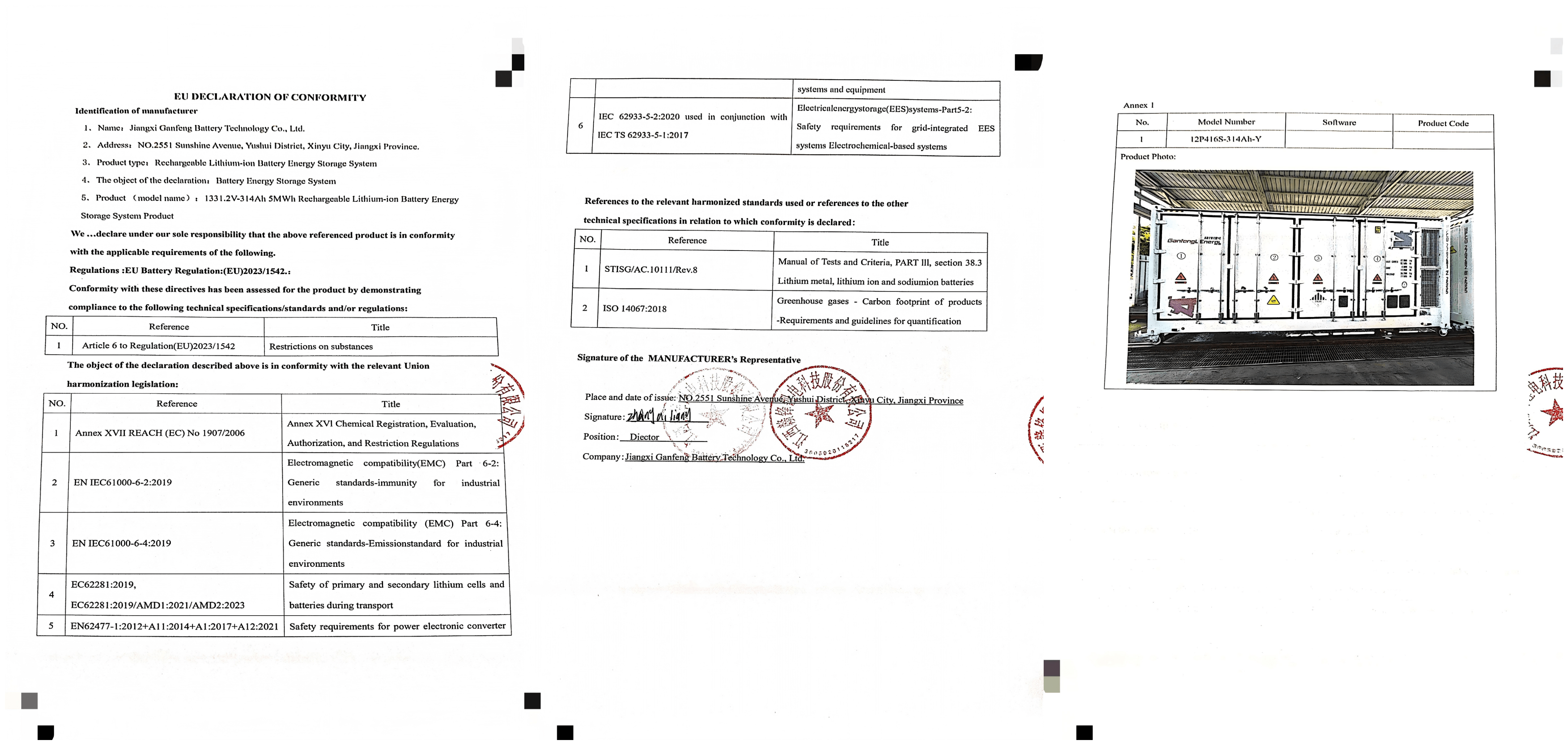
CE marking is not simply a standalone battery quality certificate. It indicates that the manufacturer has completed the applicable conformity assessment process and can declare conformity with relevant EU legislation.
For a solar battery product, the applicable requirements may depend on the battery design, electrical equipment incorporated into the product and intended use.
This is why buyers should request the manufacturer’s technical documentation and Declaration of Conformity rather than relying only on a CE logo.
3.2 IEC 62619 for Industrial Lithium Batteries
IEC 62619 is an important international safety standard covering secondary lithium cells and batteries for industrial applications.
It can be relevant to stationary energy storage products, depending on the battery design and application.
However, IEC 62619 should not automatically be described as a universal mandatory “EU certification.” Instead, buyers should determine whether it is specified by the applicable regulations, project requirements, testing program or customer specification.
3.3 RoHS and Environmental Compliance
RoHS requirements restrict certain hazardous substances in electrical and electronic equipment within their scope.
For manufacturers exporting battery systems and related electronic equipment to Europe, RoHS compliance may therefore be an important part of the overall product compliance package.
EU battery products may also be affected by additional requirements under the EU Battery Regulation. Therefore, manufacturers should review the latest applicable EU requirements before entering the market.
4. Solar Battery Certifications for the US Market
The United States does not use the CE marking system. Instead, product compliance can involve different national standards, certification schemes, electrical codes and local authority requirements.
4.1 UL 1973
UL 1973 is a widely recognized safety standard for batteries used in stationary applications and other applications covered by its scope.
For energy storage projects in the United States, buyers may encounter UL 1973 requirements in project specifications, certification programs, insurance requirements or local approval processes.
However, whether UL 1973 certification or listing is mandatory depends on the specific product, installation and applicable local requirements.
4.2 UL 9540
UL 9540 addresses energy storage systems rather than only individual battery components.
For larger battery energy storage projects, the system-level safety requirements can be different from the requirements for an individual battery module.
Therefore, a buyer should distinguish between:
- Cell-level testing
- Battery/module-level testing
- Battery system certification
- Installation and fire safety requirements
This distinction is particularly important when evaluating commercial and industrial energy storage projects.
5. UN38.3 Lithium Battery Shipping Requirements
UN38.3 is different from market-access certifications.It relates to the testing requirements used for the safe transportation of lithium cells and batteries.
If a solar battery is being exported internationally, transportation documentation and testing requirements should be checked before shipment.This is especially important for:
- Sea freight
- Air freight
- Road transportation
- Multimodal transportation
- Lithium-ion battery exports
Therefore:
UN38.3 lithium battery shipping compliance does not mean that a battery is automatically approved for sale or installation in a particular country.
It addresses transportation safety rather than general product-market authorization.
For buyers involved in international battery exports, this distinction can prevent confusion between shipping documentation and market-entry requirements.
You can also read our guide to lithium battery parameters and selection for more information about battery specifications.
6. IP Rating vs. Solar Battery Certifications: What’s the Difference?
IP ratings and solar battery certifications address different aspects of a battery product.
IP Rating
An IP rating focuses mainly on enclosure protection against:
- Dust
- Solid particles
- Water
- Water jets
- Temporary immersion, depending on the rating
It helps buyers determine whether a battery enclosure is appropriate for a particular installation environment.
Solar Battery Certifications
Solar battery certifications and compliance documents address broader requirements such as:
- Electrical safety
- Battery safety
- Environmental restrictions
- Transportation
- Market access
- System-level safety
- Local regulatory requirements
In simple terms:
IP rating = environmental protection
Certification and compliance = safety, regulatory and market requirementsA battery may have IP66 protection but still require additional compliance documentation before it can be legally sold or installed in a particular market.
Likewise, a battery can have the appropriate certifications but still be unsuitable for an exposed outdoor installation if its enclosure does not provide sufficient environmental protection.Both aspects should therefore be checked during supplier evaluation.
7. How to Check Solar Battery Market Requirements
Before purchasing or exporting a solar battery, use the following process.
Step 1: Identify the Destination Market
First determine exactly where the battery will be sold and installed.
For example:
- European Union
- United States
- United Kingdom
- South Africa
- Kenya
- Middle East
- Southeast Asia
Different countries and regions can have different regulatory requirements.
Step 2: Identify the Product Type
Determine whether the product is:
- Residential battery storage
- Commercial battery storage
- Industrial energy storage
- Mobile battery power station
- Off-grid battery system
- Grid-connected battery system
The applicable requirements may change depending on the application.
Step 3: Check the Battery Chemistry and Capacity
Lithium-ion batteries, battery modules and complete energy storage systems may have different testing and compliance requirements.
Capacity and system configuration can also influence project requirements.
Step 4: Request Compliance Documents From the Supplier
Ask the manufacturer for documents such as:
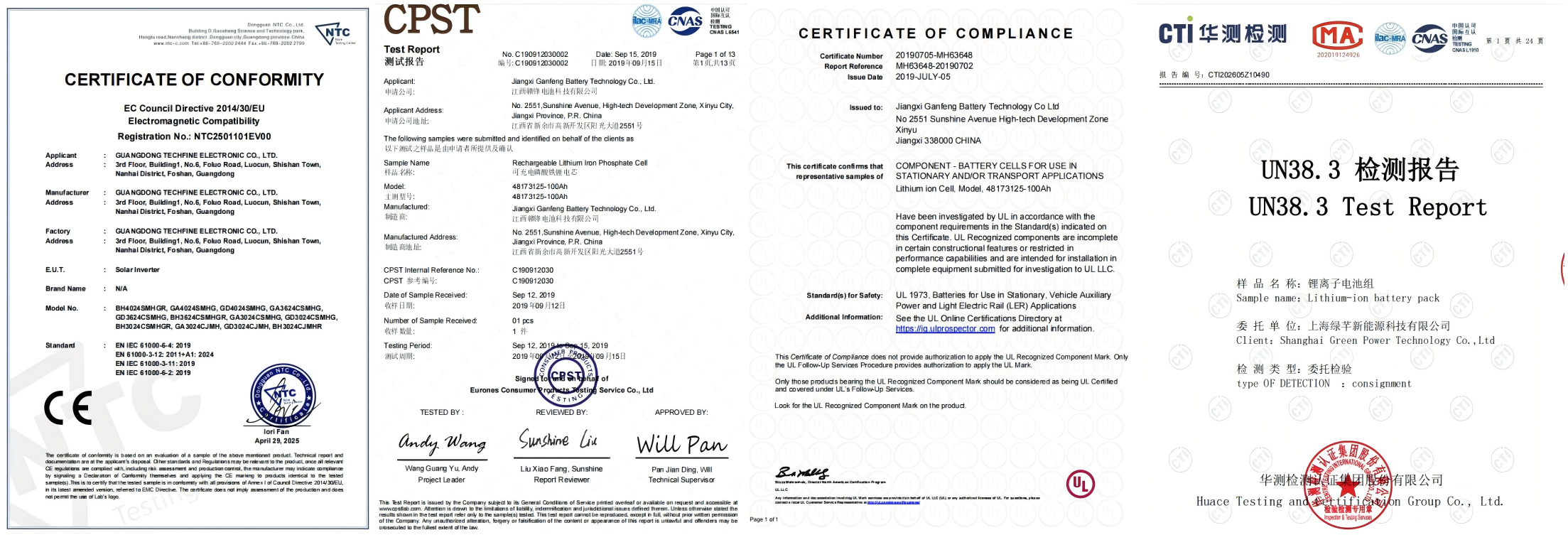
- Declaration of Conformity
- Test reports
- Relevant IEC test reports
- UL documentation where applicable
- UN38.3 test summary
- SDS / Safety Data Sheet
- RoHS documentation where applicable
- Product datasheet
- IP test report
Do not rely only on a product brochure or a certification logo printed on the battery.
Step 5: Confirm Project-Specific Requirements
For larger projects, ask the EPC contractor, project owner, local authority, insurer or technical consultant for the required standards.
This is especially important for commercial and industrial energy storage projects.
Step 6: Check Transportation Requirements
For lithium batteries, confirm the applicable transportation requirements before booking the shipment.
The freight forwarder can also help identify the documentation required for the chosen transportation method, but the manufacturer should provide the relevant technical and testing documents.
8. How to Verify a Solar Battery Supplier’s Certifications
Certification documents should be checked carefully before signing a purchase contract.
A professional buyer should verify:
1. Product model
The model number on the certificate or test report should correspond to the actual battery being purchased.
2. Manufacturer information
Check that the company name and manufacturing location are consistent across the relevant documents.
3. Standard edition
Standards can be revised. Confirm which edition of the standard was used for testing.
4. Testing laboratory or certification body
Check whether the document was issued by an appropriately qualified testing or certification organization.
5. Scope
Make sure the certificate or report covers the actual battery type and application.
6. Validity and current status
Some certificates have specific validity periods or require ongoing surveillance, depending on the certification scheme.
7. Supporting documentation
Where relevant, request the complete test report, certificate, Declaration of Conformity and other supporting documents instead of accepting only a screenshot.
This verification process can help reduce the risk of receiving incorrect, outdated or irrelevant certification documents.
9. Frequently Asked Questions
Q1: What IP rating do I need for an outdoor solar battery?
There is no single IP rating that applies to every outdoor solar battery.
IP65 can be suitable for many outdoor applications, while IP66 may be more appropriate where the battery is exposed to heavier rain or stronger water jets. IP67 may be considered where temporary immersion is a realistic risk.
The final choice should be based on the installation environment and the manufacturer’s tested specifications.
Q2: Do I need both CE and UL certifications?
Not necessarily.CE and UL relate to different regulatory and certification systems. CE is associated with applicable EU conformity requirements, while UL standards and certifications are commonly encountered in North American projects.
If a manufacturer plans to sell the same battery in both markets, separate compliance requirements may need to be addressed.
Q3: Is UN38.3 a market-access certification?
No.UN38.3 relates to the transportation safety testing of lithium cells and batteries.
It should not be treated as a general certification allowing a battery to be sold or installed in every market.
Q4: Is IEC 62619 mandatory for every solar battery?
No.IEC 62619 is an important lithium battery safety standard for industrial applications, but it should not automatically be described as mandatory for every solar battery or every country.
The applicable requirement depends on the product, market, legislation and project specification.
Q5: How can I check solar battery market requirements?
Start by identifying the destination country, battery type and application.Then check applicable government regulations, project specifications and recognized standards. You should also request current compliance documents from the manufacturer and confirm transportation requirements with the relevant logistics provider.
Q6: What documents should I ask a solar battery manufacturer for?
Depending on the product and market, buyers may request:
- Product datasheet
- Declaration of Conformity
- Relevant IEC test reports
- UL documentation where applicable
- SDS
- RoHS documentation
- IP test report
- Warranty documentation
- Installation and safety manuals
The exact documentation package depends on the destination market and application.
Conclusion
Choosing a solar battery is not only about capacity, voltage and price. Solar battery certifications, IP ratings and market-specific compliance requirements should all be evaluated before purchase and export.
For outdoor applications, check whether the battery’s IP rating matches the actual installation environment. For international projects, verify applicable CE, IEC, UL, RoHS, UN38.3 and local requirements based on the destination market.
Most importantly, do not assume that one certificate automatically provides global market access. Certification requirements can vary according to the battery type, application, country and project.
By checking the requirements before production and shipment, buyers can reduce the risk of customs delays, project approval problems, additional testing costs and compliance issues.
If you are sourcing solar batteries or energy storage systems for a specific country, work with the manufacturer and relevant local technical or regulatory professionals to confirm the current requirements before shipment.
Recommended external resources: IEC standards, UL Solutions, European Commission regulatory guidance and relevant UN transport regulations.
Post time: Aug-21-2026


