




Battery energy storage system (BESS) procurement is being reshaped by five macro forces— from tightening supply chains to the rise of AI-driven dispatch software. One theme that runs through nearly all of those trends is resilience: industrial and institutional buyers no longer want storage that simply shaves peak demand — they want storage that can keep the lights on when the grid goes down. That capability has a name: the islanded microgrid.
This post breaks down what an islanded microgrid actually is, how islanding differs from grid-connected operation, what a real islanded microgrid system looks like in the field, and how a landmark U.S. military project — the Ameresco Parris Island microgrid— put all of these concepts into practice.
Islanded Microgrid Meaning
The islanded microgrid meaning is simpler than it sounds. An islanded microgrid is a local power network — combining generation assets (solar PV, combined heat and power, diesel or gas generators) with battery storage and a control system — that can physically and electrically detach itself from the main utility grid and continue supplying power to its own loads. When the wider grid experiences an outage, storm damage, or a planned maintenance event, an islanded microgrid “islands” itself, meaning it isolates from the upstream utility and runs autonomously on its own onsite generation and stored energy.
This is different from a simple backup generator. An islanded microgrid coordinates multiple energy sources in real time, balances supply and demand automatically, and re-synchronizes safely with the grid once utility power is restored — all without manual intervention.
Islanding and Grid-Connected Mode: Two Sides of the Same System
Every modern microgrid is designed to operate in two states, and understanding islanding and grid-connected mode microgrid behavior is essential to designing one correctly:
- Grid-connected mode: The microgrid operates in parallel with the utility grid. It can import power when onsite generation is insufficient, export surplus power back to the grid, or simply reduce demand charges by dispatching stored energy during peak-price periods.
- Islanded mode: The microgrid controller detects a grid disturbance or outage and disconnects the site from the utility feed within milliseconds, shifting the site’s loads onto onsite generation and battery storage.
The transition between these two states is the hardest engineering problem in microgrid design. A poorly tuned controller can cause voltage or frequency instability during the switch; a well-designed one makes the transition invisible to the people and equipment inside the facility.
What Makes Up an Islanded Microgrid System
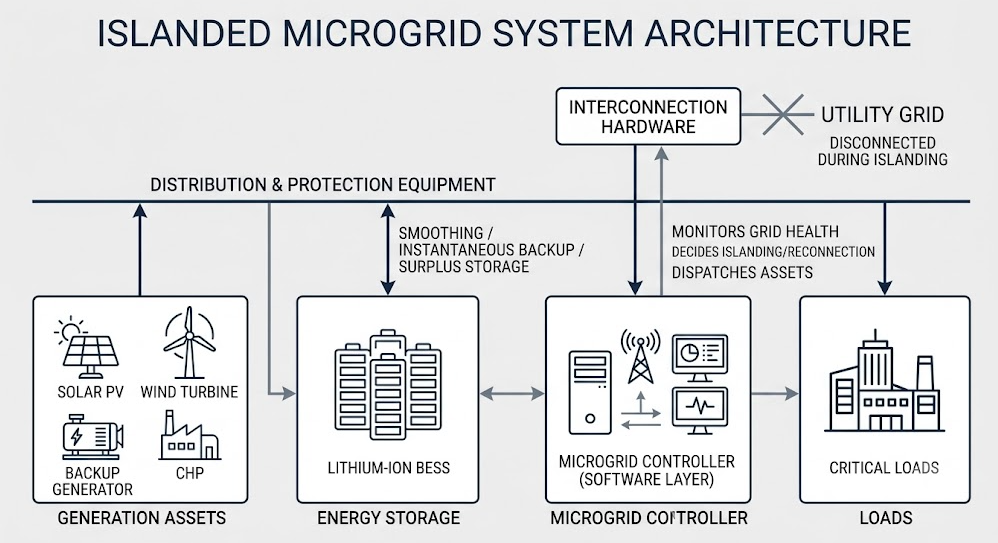
A functioning islanded microgrid system typically combines four layers:
1.Generation assets — solar PV arrays, combined heat and power (CHP) plants, wind, or backup generators that produce power onsite.
2.Energy storage — lithium-ion battery energy storage systems (BESS) that smooth output, provide instantaneous backup during the islanding transition, and store surplus renewable generation for later use.
3.Microgrid controller — the software layer that continuously monitors grid health, decides when to island or reconnect, and dispatches each asset according to site priorities and load-shedding rules.
4.Distribution and protection equipment — switchgear, relays, and interconnection hardware that physically separate the site from the utility grid during an islanding event.
Sizing and integrating these layers correctly is a specialized task — one that mirrors the same procurement discipline covered in our BESS trends article, since battery capacity, chemistry, and controller compatibility all determine how reliably a system can island and re-connect. If you’re evaluating a turnkey solution for a campus, industrial site, or remote facility, our mini-grid solutions page outlines configurable systems built around exactly this architecture.
Microgrid Island and Non-Islanded Mode: Why the Distinction Matters for Design
Not every microgrid is built to island, and that distinction matters for both cost and risk. The difference between microgrid island and non-islanded mode capability comes down to whether the system includes the protective relaying, black-start capability, and controller logic needed to safely disconnect from the grid and keep operating.
- A non-islanded microgrid (sometimes just a distributed generation or DG system) can offset grid consumption and participate in demand response, but it shuts down along with the grid during an outage — it has no ability to operate independently.
- A true islanded microgrid is engineered from the ground up for autonomous operation, including black-start sequencing (the ability to restart generation assets with no grid power present at all) and load-shedding logic to keep critical circuits energized when total available capacity is limited.
For mission-critical sites — hospitals, data centers, military installations, water treatment plants — paying for true islanding capability is usually non-negotiable. For general commercial or light-industrial sites, a non-islanded, grid-connected-only system may be sufficient and considerably cheaper.
DR Island Systems and Microgrid Projects: Adding Demand Response
Increasingly, islanded microgrid projects are being paired with demand response (DR) programs. In these DR island systems or microgrid project configurations, the same controller and battery assets that enable islanding are also used, during normal grid-connected operation, to respond to utility DR signals — discharging batteries or curtailing non-critical loads during system-wide peak events in exchange for incentive payments or lower tariffs.
This dual-use design is one of the clearest examples of the “make the asset pay for itself twice” logic that’s now standard in industrial BESS procurement: the same battery bank that provides emergency backup during islanding also generates ongoing revenue or savings from demand response and peak shaving during everyday grid-connected operation.
Case Study: The Ameresco Parris Island Microgrid
One of the most complete real-world examples of these principles in action is the Ameresco Parris Island microgrid, built for the U.S. Marine Corps Recruit Depot (MCRD) in Port Royal, South Carolina — an 8,095-acre installation that trains roughly 20,000 recruits a year in a region regularly exposed to hurricanes.
After a competitive solicitation from the Naval Facilities Engineering and Expeditionary Warfare Center (NAVFAC EXWC), Ameresco was awarded a $91.1 million task order, delivered as a self-funding Energy Savings Performance Contract (ESPC) that required no upfront capital from the Marine Corps. The completed system integrates:
- A new 3.5 MW gas-fired combined heat and power (CHP) plant, replacing an aging, end-of-life steam plant and eliminating the base’s reliance on fuel oil.
- 6.7 MW-DC of onsite solar photovoltaic generation.
- A 4 MW / 8.1 MWh lithium-ion battery energy storage system.
- An advanced microgrid controller capable of continuously monitoring utility health, coordinating dispatch across all generation and storage assets, executing load shedding when necessary, and automatically re-synchronizing the site once utility service is restored.
- Energy and water efficiency retrofits across 121 buildings, including more than 29,000 high-efficiency LED fixtures.
Together, these assets total roughly 10 MW of onsite generation capacity — enough to let Parris Island “island” itself from the utility grid entirely and keep critical training operations running through a regional outage. The project cut utility energy demand by around 75–79% and reduced water consumption by roughly 25–27%, while Ameresco continues to operate and maintain the system under a 22-year contract.
Parris Island is a useful reference case precisely because it demonstrates every layer discussed above in one deployment: dispatchable generation, battery storage sized for both backup and daily optimization, a controller built for both islanding and grid-connected mode microgrid operation, and a procurement structure (ESPC) that shifted capital risk away from the end customer — the same kind of flexible, service-based ownership model highlighted as a growing trend in industrial BESS procurement generally.
Getting Islanding Capability Right from the Start
Whether you’re evaluating a facility retrofit, a campus-wide resiliency upgrade, or a remote site with no reliable grid connection at all, the questions are largely the same: How much of the site’s load truly needs to survive an outage? What battery chemistry and capacity actually support that load through a multi-hour or multi-day event? And does the controller logic support a clean transition between grid-connected and islanded operation?
These are the same procurement questions industrial buyers are now asking at scale — and they’re exactly what our mini-grid solutions are designed to answer, with configurable generation, storage, and control packages built for sites that need to keep running no matter what the utility grid is doing.
Ready to design a resilient energy system for your facility? [Explore Our Mini-Grid Solutions] or [Talk to an Energy Storage Expert]
Post time: Jul-14-2026


