




Executive Summary
The record-breaking heatwaves of 2026 have highlighted a growing global challenge: keeping buildings cool without facing soaring electricity bills. While the latest El Niño cycle has intensified temperatures, climate scientists agree that long-term greenhouse gas accumulation has permanently raised global temperature baselines. Extreme summer heat is increasingly becoming the new normal rather than an occasional event.
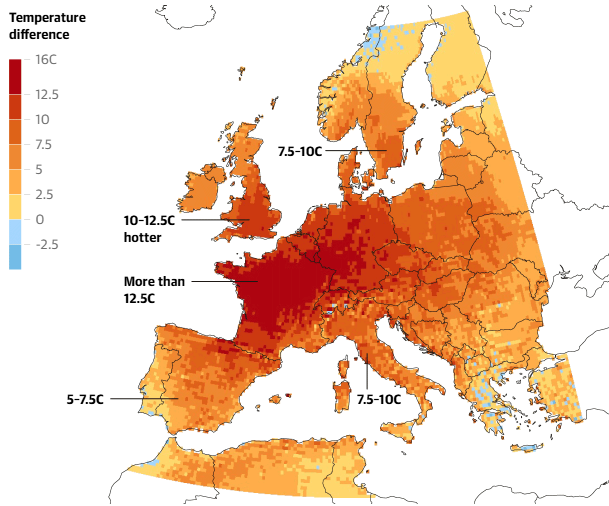
Europe faces its most intense heatwave on record
As temperatures climb, electricity demand rises sharply due to continuous air-conditioning use, placing enormous pressure on power grids and driving up electricity prices through time-of-use (TOU) tariffs and peak-demand charges. This report explains why electricity costs surge during heatwaves and how PV energy storage systems provide one of the most effective long-term solutions for reducing utility expenses while improving energy resilience.
Why Do Electricity Bills Skyrocket During Heatwaves?
During prolonged heatwaves, electricity consumption increases much faster than temperature itself. Once ambient temperatures exceed approximately 38°C (100.4°F), cooling demand can account for nearly half of total peak electricity consumption in many regions.
This creates two simultaneous challenges.
Grid Demand Reaches Critical Levels
Continuous operation of air-conditioning systems causes electricity demand to surge during the hottest hours of the afternoon. Utilities respond by activating expensive peak-generation resources and implementing higher TOU pricing or demand charges, making electricity significantly more expensive precisely when cooling is most needed
Conventional Power Plants Lose Efficiency
Extreme heat also reduces the cooling efficiency of coal-fired and gas-fired power plants. Studies indicate thermal efficiency can decline by 5%–12% during severe heatwaves, reducing available electricity supply exactly when demand reaches its highest point.
The result is a combination of constrained supply and soaring demand that leads directly to high electricity bills for homes and businesses.
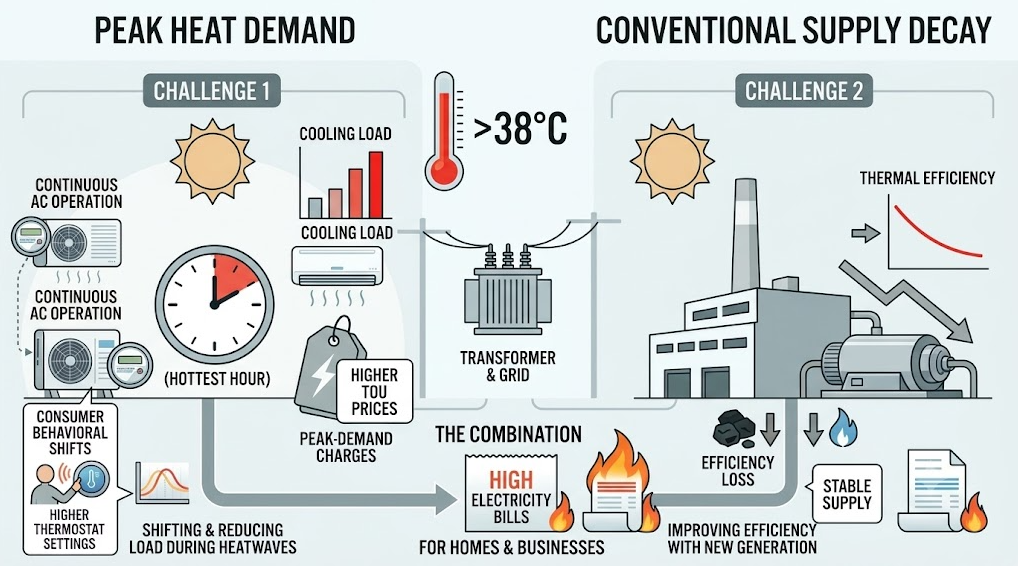
The prolonged heatwave continues to drive up electricity bills
How PV Energy Storage Systems Reduce High Electricity Costs?
Unlike conventional solar systems that only generate electricity during daylight hours, a complete PV energy storage system stores surplus solar power for later use. This transforms solar generation from a daytime-only resource into a reliable 24-hour energy solution.
1. Store Cheap Solar Energy for Expensive Evening Hours
Solar panels often produce their highest output between 11:00 AM and 3:00 PM, while electricity prices frequently peak later in the evening when solar production has declined but cooling demand remains high.
Instead of exporting excess electricity back to the grid at relatively low feed-in tariffs, battery storage captures this surplus energy and supplies it during expensive peak-price periods. This reduces dependence on utility electricity when prices are highest and directly lowers cooling costs.
2. Peak Demand Shaving for Commercial Facilities
For commercial and industrial customers, electricity bills are often influenced not only by energy consumption but also by the highest demand recorded during a billing cycle.
When multiple HVAC systems start simultaneously during extreme heat, battery storage can instantly provide supplemental power, reducing the facility’s peak demand and significantly lowering monthly demand charges.
3. Maintaining Cooling During Grid Stress
Heatwaves often coincide with overloaded transmission networks and localized power interruptions. Energy storage systems provide backup electricity for essential cooling equipment, helping businesses maintain operations and protecting homes from uncomfortable indoor temperatures during outages.
Heatwaves Also Challenge Energy Storage Systems
High temperatures affect not only the grid but also renewable energy equipment itself.
Traditional P-type photovoltaic modules experience noticeable efficiency losses as panel temperatures rise above 65°C. Newer N-type solar modules offer lower temperature coefficients, enabling better power generation during extreme summer conditions.
Battery systems face similar challenges. High ambient temperatures accelerate lithium-ion battery aging and increase thermal management requirements.
For this reason, Liquid-Cooled Battery Energy Storage Systems (Liquid-Cooled BESS) have become the preferred solution for commercial and utility-scale installations. By maintaining cell temperature differences within approximately 3°C, liquid-cooling technology improves operational stability, extends battery life, and enhances long-term return on investment compared with conventional air-cooled systems.
From Electricity Savings to Long-Term Energy Resilience
The role of energy storage has evolved beyond simple electricity bill reduction.
Traditionally, battery storage was viewed primarily as a tool for peak-price arbitrage. Today, under increasingly frequent extreme weather conditions, it has become a critical component of resilient energy infrastructure.
A properly designed solar-plus-storage system helps organizations:
- Reduce high electricity bills during extreme heatwaves.
- Lower exposure to volatile TOU electricity pricing.
- Decrease peak-demand charges.
- Improve business continuity during grid disruptions.
- Increase energy independence while reducing carbon emissions.
Rather than serving only as a seasonal cost-saving measure, energy storage has become a strategic long-term investment that strengthens operational resilience against future climate risks.
Conclusion
Extreme heatwaves are no longer isolated weather events—they are becoming a recurring feature of the global climate. As electricity demand continues to climb during hotter summers, relying solely on grid power exposes both households and businesses to escalating utility costs and increasing grid uncertainty.
By combining high-efficiency photovoltaic modules with advanced battery energy storage systems, especially liquid-cooled BESS technologies, organizations can shift electricity consumption away from expensive peak periods, reduce dependence on overloaded grids, and maintain reliable cooling when it matters most.
In an era of climate normalization, investing in PV energy storage systems is no longer simply about generating clean electricity. It is about controlling energy costs, improving resilience, and building a more secure and sustainable energy future.
Frequently Asked Questions (FAQ)
1.How much battery storage do I need for air conditioning?
If you simply want to power your air conditioning using the battery during the peak-rate hours of the day, a residential energy storage battery with a capacity of 10–15 kWh is usually sufficient; however, if you aim for complete off-grid self-sufficiency throughout the night, a setup providing at least 20–40 kWh is required to power air conditioning for the entire house.
2.Can battery storage work during a blackout?
Yes, battery storage can work during a blackout, but it is not automatic for every system.
To keep your power on when the grid goes down, your system must meet two key requirements:
- You Need a Grid-Tied Inverter with “Island Mode” (or an Off-Grid Inverter)
- You Must Configure “Essential Loads”
3.How long does a BESS last in hot climates?
In hot climates, a Battery Energy Storage System (BESS) typically lasts 7 to 10 years if it relies on standard cooling, compared to the 15-year lifespan often expected in temperate regions.
4.Is liquid-cooled BESS worth it?
To put it bluntly: if you are operating in a region with high ambient temperatures, heavy cycling demands, or strict space constraints, yes, a liquid-cooled BESS is absolutely worth it. While liquid-cooled systems carry a 15% to 25% higher upfront capital cost (CAPEX) compared to traditional air-cooled systems, they consistently deliver a lower Levelized Cost of Storage (LCOS) and a higher Return on Investment (ROI) over the project’s lifespan.
5.Can solar panels still generate electricity during extreme heat?
Yes, solar panels absolutely still generate electricity during extreme heat, but they become significantly less efficient at doing so.Even with reduced efficiency, hot summer days still offer the longest daylight hours of the year, which usually results in a net high energy yield—but a robust commercial system must be designed to withstand these thermal efficiency dips.
6.What size PV energy storage system is right for my home or business?
Sizing a PhotoVoltaic (PV) energy storage system is never a one-size-fits-all calculation. The right setup depends entirely on whether you are optimizing a household or a business, and what your ultimate goal is: saving money on tariffs, achieving total grid independence, or securing emergency backup.
Post time: Jul-10-2026


